
A group with companies in several countries usually closes the month twice. Each company closes its own books, in its own currency and often in its own system, and then someone exports every trial balance, converts it at whatever rates the spreadsheet holds, strips out what the companies sold to each other and rebuilds the group’s statements by hand.
Nama ERP takes the second close away. Every company in the group lives in one database, each keeps its books in its own currency, and multi-currency consolidation is three system reports: a consolidated trial balance, income statement and balance sheet, translated into one reporting currency, with the intercompany figures eliminated, every time they run.
The examples below come from Rawafed Learning Group, a group we invented to build the demo: a head office in Lebanon keeping its books in US dollars, subsidiaries in Egypt, Saudi Arabia, the UAE and Algeria in their own currencies, and a sixth company that exists only for consolidation adjustments. Ten months of transactions, about 1,350 documents, reported in USD.
Each company in its own currency
A company in Nama points to a ledger, and the ledger sets its main currency. Egypt posts in pounds, Saudi Arabia in riyals, the head office in dollars, all in the same database.
They still share one chart of accounts. An account marked Use Transaction Local Currency takes the currency of whichever company posts to it, so “Cash in Banks – Local Currency” is one account that holds pounds in Egypt and dinars in Algeria. Nobody maintains five copies of the chart, and a report that groups by account sees the same account in every company.
One item record for every company
An item saved without a company is public, and one setting makes public records visible from inside every company. The group keeps one item master: one code, one description, one unit of measure, used by every company that buys or sells it. There is no copy per company and nothing to keep in step.
That sounds like housekeeping, and it is also what makes the hardest elimination possible. When the head office sells stock to Egypt, both companies are moving the same item record, so the system can follow it from the seller’s invoice to the buyer’s shelf. More on that below.
Transactions between companies in different currencies
The Inter Company Transfer posts both sides in one step: a journal entry in each company, balanced on the other company’s current account. Across currencies, each side is booked at its own ledger’s rate. When the head office charges Egypt a USD management fee, the head office books dollars and Egypt books the pound equivalent at its rate for that date. The document asks for one transaction currency on every line, so both current accounts carry the same dollar figure.
Stock and fixed assets are different. A stock transfer or an asset transfer between two companies works when both use the same currency. Across currencies it is refused with a message that says what to do instead, because that is not how a group actually moves goods across a border: one company issues a sales invoice and the other books a purchase invoice. The consolidated reports then remove the sale, as they should.
The journal entries guide covers the transfer document itself.
Three consolidated statements
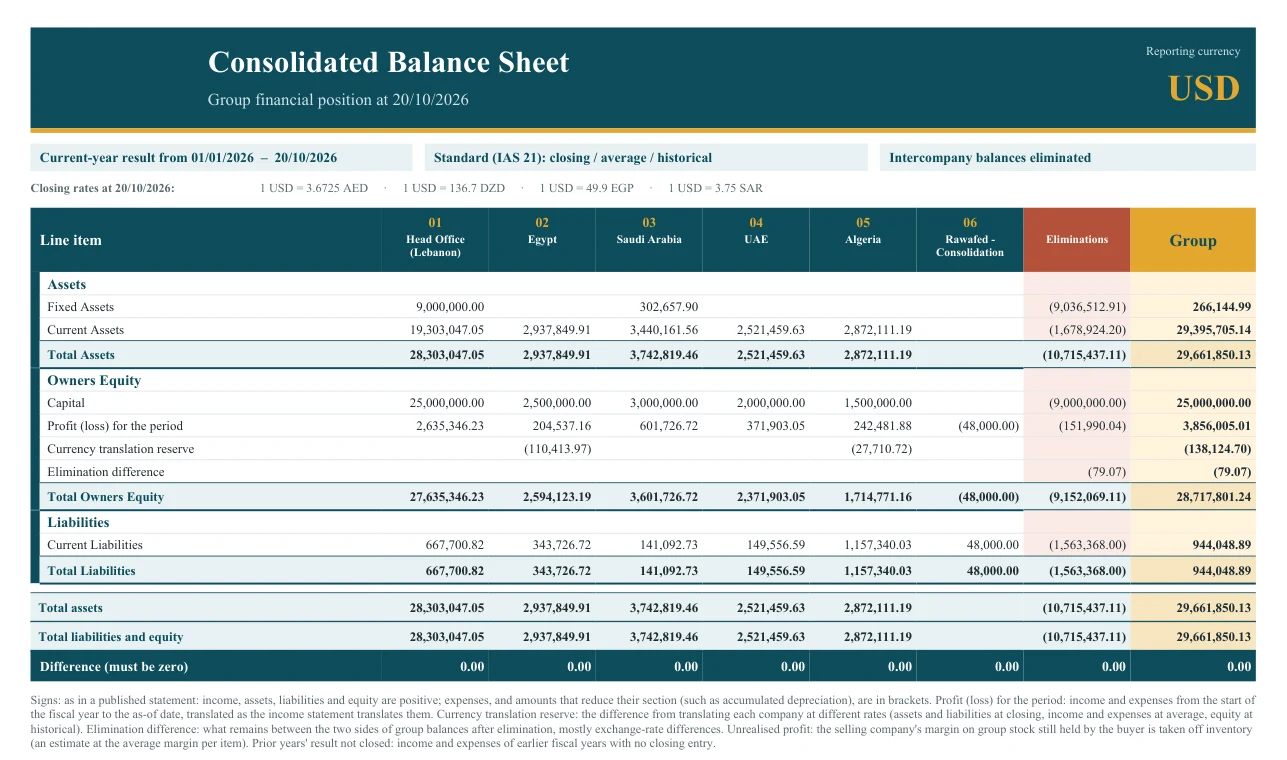
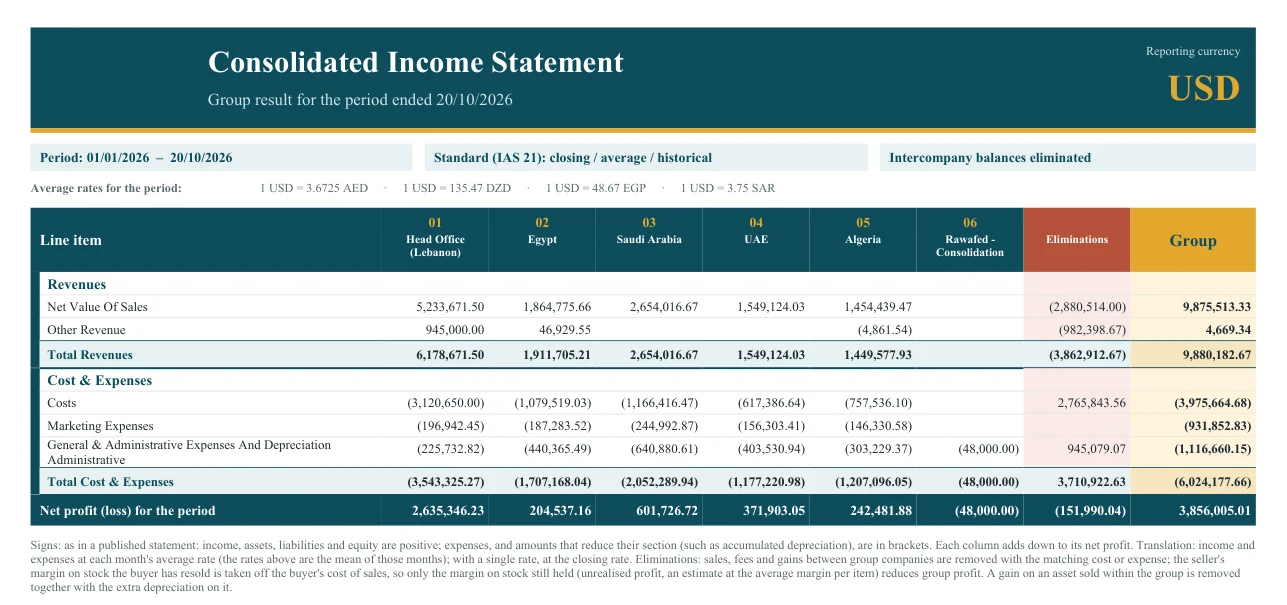
The Consolidated Trial Balance, Consolidated Income Statement and Consolidated Balance Sheet share one layout: a column for each company, an Eliminations column, and the Group column. Every company’s figures are already translated into the reporting currency, so each column can be read on its own and the row adds across.
When you run them you choose:
- the reporting currency, which defaults to the reporting currency set on the ledger;
- the period, or the as-of date for the balance sheet;
- the translation method (below);
- which companies to include;
- whether to eliminate intercompany figures.
The rates used are printed in the report header, and the balance sheet ends with a “Difference (must be zero)” row for every column. The statements come in English and Arabic, with the Arabic page mirrored right to left. The consolidated statements guide covers the parameters, the exchange rates the reports need and how to set a group up for them.
Translation under IAS 21, or at one rate
The Standard method follows IAS 21:
- assets and liabilities at the closing rate on the reporting date;
- income and expenses at each month’s average rate;
- equity at the historical rate, the rate the entry was booked at.
The three rates never agree, so a company’s translated trial balance does not balance on its own. The difference is the currency translation reserve, which the report computes and prints in equity. It is not posted anywhere. In the demo the Egyptian pound went from 47.60 to 49.90 to the dollar over the year and the Algerian dinar from 134.20 to 136.70. The capital the head office put into those two companies is worth fewer dollars at today’s rate than when it was paid in, and the reserve reflects it: USD (138,124.70) for the group at 20 October.
The Single closing rate method translates everything at the closing rate. The reserve is then zero, which some groups prefer for management reporting.
Which rate an account uses is a field on the account and on the account chart, Consolidation Rate. Left empty, balance-sheet accounts translate at closing and income-statement accounts at average, so most charts need one change: set Historical once on the equity chart, and every account under it follows. An auditor who asks which rate an account uses gets the answer from the account screen.
The rates come from the group’s own exchange rate records, the ones with no company set. They are kept in a cross-rate table that is rebuilt whenever an exchange rate document is saved, so a pound-to-dollar rate is available even when a ledger only holds the dollar-to-pound one.
Eliminations
The reports eliminate from one flag. Intercompany is a tick on the account and on the account chart, and a chart that has it passes it to every chart and account beneath it. Group receivables and payables, intercompany sales and their cost, management fees and the current accounts are flagged once. From then on, every flagged row moves into the Eliminations column with the opposite sign and stays out of the Group total.
What does not net to zero prints as an elimination difference. It is usually the exchange difference between two sides booked at different rates, and in the demo it is USD 79.07 on ten months of management fees. A number that size is easy to explain. A large one points at an intercompany document one side never booked.
One case needs more than the flag: an asset sold inside the group. Egypt sold a piece of production equipment to the Saudi company at a gain. The gain is eliminated, the buyer’s asset is reduced by the same amount, and the extra depreciation the buyer charged on that amount is reversed as well.
Unrealised profit in stock
When the head office sells stock to a subsidiary at a margin, that margin is not the group’s profit until the stock is sold to an outside customer. Whatever is still on the subsidiary’s shelf at the reporting date carries profit the group has not earned.
The reports compute it. For each buying company and item, the quantity still held from purchases from group companies is multiplied by the average margin per item the group’s sellers made on intercompany sales of it in the period. That amount comes off inventory. The margin on the part already resold comes off the buyer’s cost of sales, so the group shows only the profit it made from outside customers.
This is an estimate, and the report’s notes say so: it uses an average margin per item, not the margin of each individual delivery. It is possible at all because of the shared item master, which lets the system match the buyer’s stock to the seller’s invoices without anyone mapping item codes between companies.
Adjustments no report can compute, such as a fair-value adjustment or a prior-year correction, are ordinary journal entries in a company kept for consolidation adjustments. It has its own column, so an auditor sees them apart from the operating companies.
Computed every run, nothing to reverse
None of this is posted. Eliminations, unrealised profit and the translation reserve are worked out each time the report runs, from the books as they stand. Post a late invoice in Algeria and the next run includes it. There is no consolidation journal to reverse at the start of the next period and no second set of books to keep in step with the first.
The video walks through the demo group and the three statements:

You can also watch it on YouTube. For how the companies themselves share one database, see every company in one database.