
Motor Trade
The showroom and the workshop — vehicles costed one by one, repairs billed to whoever owes.
A dealership looks like one business from the street and runs as two behind the counter. The showroom's problem is identity: six cars of one model on the yard are six costs, six customs files and six promises, because nobody buys a unit of stock — they buy a chassis. The workshop's problem is capacity and who pays: the day is sold before it is worked, and one visit can carry a service the owner settles, a component the warranty covers and damage an insurer is arguing about. Nama runs both halves on one ledger and is candid that they are two systems, which is exactly what lets the workshop serve cars the showroom never sold.
What Motor Trade covers
2 modules, licensed together or separately.
The workshop half, sold before it is worked
One repair, four payers
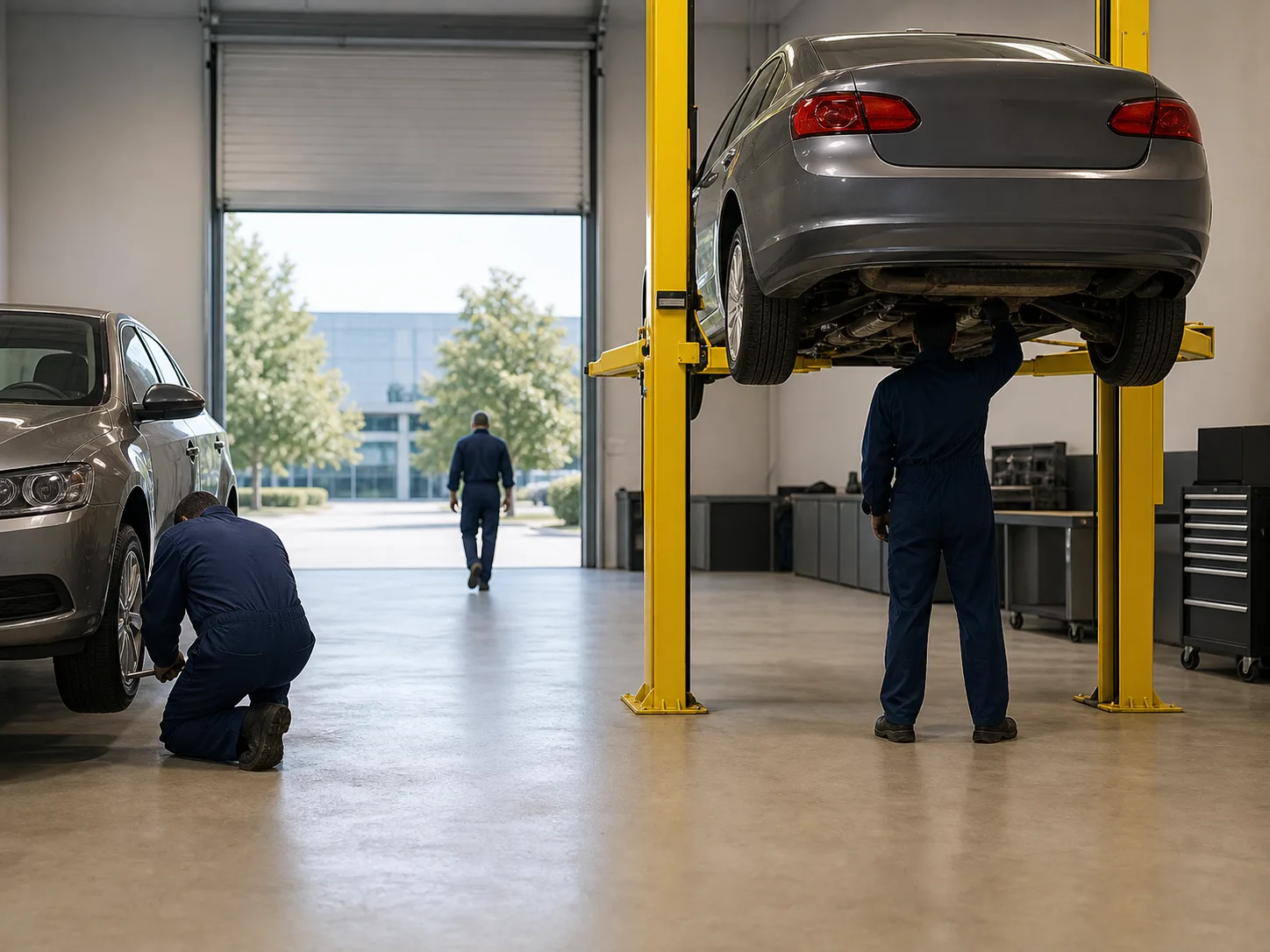
Bays multiplied by hours become a published capacity, and every booking is checked against the day it asks for. Each operation and each spare-part line then carries its own split - the customer, the insurer, the warranty provider, and what the company absorbs itself.
How it works together
Two menus, two registers, one ledger. Reading the day in order is the quickest way to see where each half earns its keep.
- Bring the cars in. Purchase order, proforma invoice, purchase invoice and receipt — and exactly one of those four is switched on to create the vehicle records, most often the purchase invoice, since that is where the purchase is booked. The habit that goes with it is one line per chassis.
- Hold them one at a time. Each physical car is a record hung off an ordinary supply-chain item, and quantity and inventory cost are held against the pairing rather than the model. Import charges land as service lines on the purchase invoice, so the vehicle that waited a fortnight at the port carries what that cost.
- Draw the lifecycle you actually run. Twenty status names ship as a catalogue and none of them is wired to a document until you write the row that wires it. An importer’s franchise and a used-car lot build very different chains out of the same list.
- Sell a chassis, not a model. Quotation, order, allocation, invoice, final delivery, with the traffic letter alongside. Only the invoice is a financial event; what stops two salespeople selling the same car is the lifecycle refusing the second move rather than a flag on the record.
- Publish the workshop’s day before selling it. Bays multiplied by hours become a published capacity split across appointments, carry-over, walk-ins and emergencies, and a booking is checked against the day it is asked for.
- Divide the repair, then release the car. The four payer columns run from the estimate through to the closing, and the gate pass at the exit asks one question: has everybody who owes something been invoiced, and paid. Each check is a permission on the document term, so a workshop decides which of them to enforce.
The seam between the two halves is worth stating plainly rather than discovering in month three: they meet in the settings screen and nowhere else. That is not a defect to work around so much as the reason the workshop is worth buying on its own — an independent service centre repairs whatever comes through the gate, and nothing in the module ever asks who sold the car. The overview says it in the product’s own words under the sold car and the serviced car, and the payer arithmetic is set out in who pays for what.
Built for how the region actually works
Dealers here import rather than manufacture, so the number that decides whether a sale was good is landed cost per chassis — the invoice from the principal plus freight, customs and clearance, attached to the car those charges actually belonged to rather than smeared across a shipment. The customs block on the vehicle’s own screen keeps the list number, the release date, the vessel and the carrier where the paperwork can be found, which matters on the day an authority asks.
The rest reflects how the trade sells. Insurance and finance are closed across the same desk as the car, so the programmes behave as rate cards the salesperson quotes from. Franchised workshops carry manufacturer warranty and recall obligations, which is why a job order for a car caught by an open campaign is refused until the campaign is named on it. And a service department that is not franchised takes every make on the road, bills its own catalogue hours rather than the hours the technician spent, and prints a job sheet, a gate pass and an invoice that all read right-to-left.
Every screen, field and setting is documented in full.
Read the documentation →Good question — already answered
Does a car we sold appear automatically in the workshop's register?
No, and planning around the assumption is the most expensive mistake on this module. The vehicle file the workshop opens and the car record the showroom sells are two unrelated records, and no document in either half writes to the other. When a customer brings a car back for its first service, the advisor opens a fresh vehicle file and types the plate, chassis and odometer. Matching a repair back to the sale that produced it is a custom report or an integration keyed on the chassis number.
Can we licence one half without the other?
Yes. The workshop and the dealership sit behind different codes, and a service centre that never sells cars buys only the workshop. One warning about the combination: the insurance and instalments licence is not self-contained, because the insurance company master file belongs to the dealership licence — so financing and insurance are bought together with the showroom half rather than on their own.
Can one repair be billed to more than one payer?
Yes, line by line. Every operation and every spare-part line carries four percentages — the customer, the insurer, the warranty provider and what the company absorbs itself — applied to the line's value after discounts. There is one insurer and one warranty provider per job order, so a single line cannot be divided between two different insurers. The closing's own journal entry carries the customer's share; the other parties reach the ledger through their own invoices.
How much of this works before configuration?
Almost none of it, and the honest answer saves an implementation. Every record and document in the module is licence-gated, and vehicle tracking specifically stays inert until a status configuration is attached to the item: which document moves a car to which status, and which status changes are legal, are tables you fill in yourself. On an installation where nobody attached one, the documents all save successfully and change nothing.
Do we get profit per vehicle?
On the showroom side yes, because cost is held against the pairing of item and individual car rather than averaged over the model, so the cost of sale on an invoice is that chassis's own — freight and customs included, where they were landed onto the purchase. The workshop is a different question: its closing books the customer's share, and what the insurer and the warranty provider owe becomes revenue when their invoices are raised.
Industries that lean on this
Companies already running Nama ERP








When I joined the company I found that the system in use was Namasoft's, but it was not fully operational — parts of it were not working. I took on the challenge, we surfaced every problem in it, and within six months it was running and the system had been configured to match the way we work.
Get started with Nama today
Tell us how your business runs and we will show you how Nama ERP fits it — in your language, on your infrastructure.